
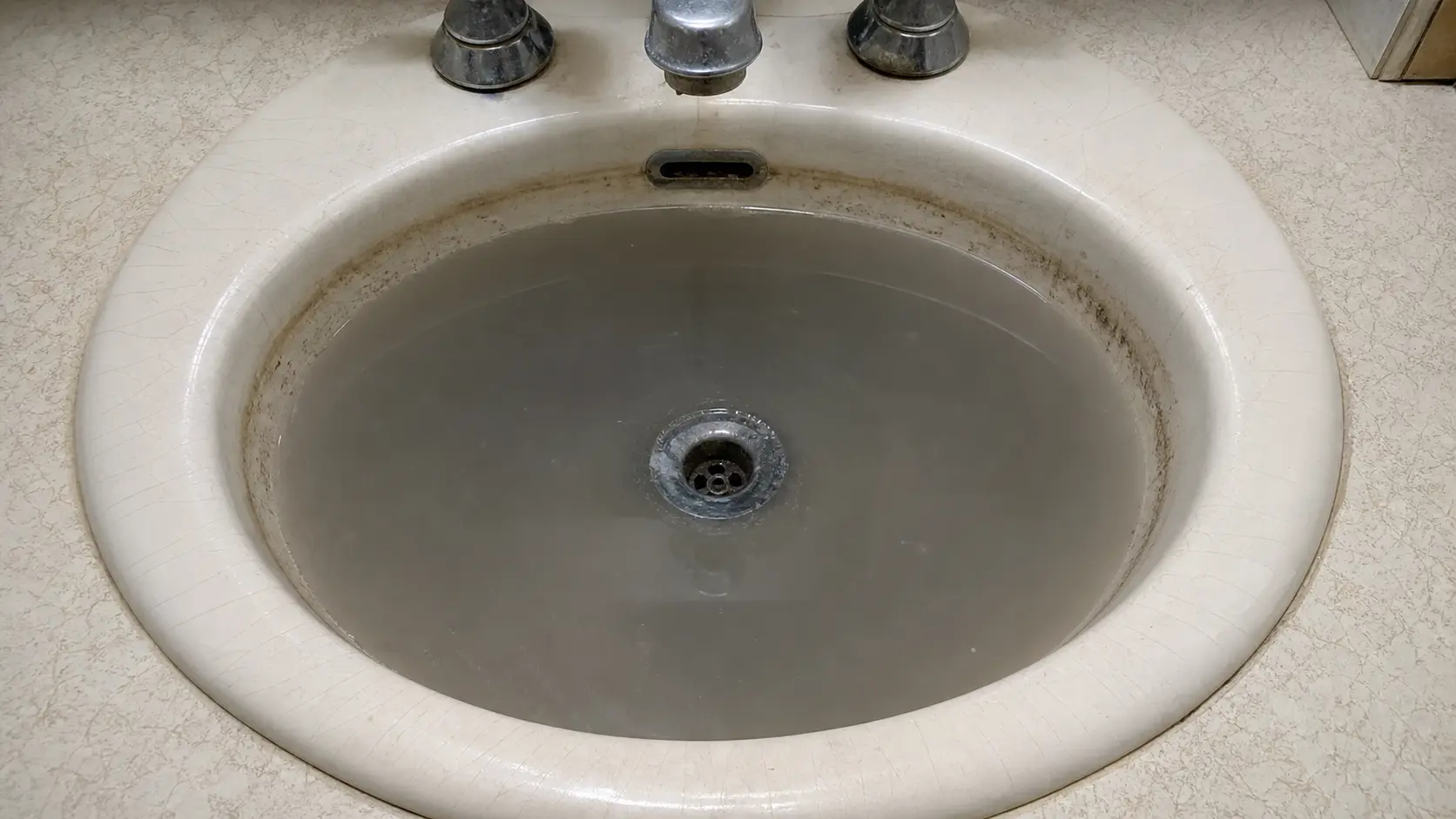
1. It drains slower than it used to
The most common early warning, and the easiest to ignore because it happens gradually.
Sudden blockages are usually objects. Gradual slowing is usually buildup: grease coating a kitchen line, hair and soap in a bathroom line, mineral scale narrowing older cast iron. The pipe is not blocking, it is getting narrower.
What it points to: accumulation on the pipe wall rather than a discrete clog. Which matters, because a cable will punch through a coating and the line will slow again in a few months. That pattern is what makes people think their drain "never really got fixed".
When to act: if it has been getting worse for weeks rather than days, and a plunger has not helped, it is worth a call. It is not urgent.
2. It gurgles
Gurgling is air being pulled through standing water where it should be moving freely. It is one of the more informative symptoms, and people consistently underrate it.
The really useful version is when one fixture gurgles while a different one runs. A toilet that gurgles when the washing machine drains. A shower that burbles when the kitchen sink empties. Two fixtures talking to each other means they share a line, and the restriction is downstream of both.
What it points to: a partial blockage in a shared branch line or the main sewer line, or a venting problem. Not a clog in the fixture you are standing at.
When to act: soon. Gurgling across fixtures is the clearest early sign of a main line issue, and main line issues do not improve on their own.
3. There is a smell
Two common causes, and they need different responses.
A dry trap is the harmless one. Every drain has a U-shaped trap holding a little water, which blocks sewer gas from coming back up. In a guest bathroom or a floor drain that never gets used, that water evaporates and the seal is gone. Run water down it for thirty seconds and the smell goes.
The other cause is waste sitting in the line because a partial blockage is holding it there. That smell does not go away when you run water, and it often gets worse.
What it points to: if running water fixes it, nothing. If it does not, something is holding waste in the pipe.
When to act: try the water first. If the smell persists, call.
Two of these at once usually means the main line rather than the fixture. Describe what you are seeing and we will tell you which, on (720) 794-0974.
4. Water rises in one fixture when you run another
The single most diagnostic sign on this list.
Run the bathroom sink and the shower fills slightly. Flush the toilet and the tub gurgles or rises. Empty the washing machine and the basement floor drain comes up.
This means both fixtures drain into the same line and that line cannot take the flow. The restriction is downstream of both, which puts it in a shared branch or the main sewer line.
What it points to: a main line restriction, almost always. In older Denver housing that frequently means roots at the joints of a clay lateral. In newer housing it usually means accumulated grease or wipes.
When to act: promptly. This is the stage before a backup, and dealing with it now is considerably cheaper and less unpleasant than dealing with it once wastewater is on a floor.
5. The same drain clogs on a schedule
Every spring. Every six months. Roughly the same interval, every time.
A clog that returns predictably is the clearest evidence that clearing has been treating a symptom rather than a cause. Something is regrowing or reaccumulating, and the interval tells you roughly how fast.
What it points to: in Denver, a spring-timed main line blockage is very often root intrusion. Root growth accelerates as soil warms, so a line that coped through winter stops coping in March or April. A kitchen line blocking every few months regardless of season is usually grease coating the pipe.
When to act: before the next cycle rather than during it. And this is the situation where a camera inspection earns its cost, because clearing the same line indefinitely without ever finding out why is the expensive option.
6. The basement floor drain does anything at all
Worth treating as its own category, because it is widely misread.
The basement floor drain is normally the lowest opening in the whole system. Water finds the lowest point, so when a main line cannot take what the house is sending, that is where it surfaces.
Which means a floor drain that backs up is almost never a floor drain problem. It is the main line reporting a restriction, and the floor drain is simply where you find out.
It also explains the timing people find confusing. It often happens while the washing machine is running or a bath is emptying, because those discharge a large volume quickly and a restricted line cannot clear it fast enough.
What it points to: a main sewer line restriction, downstream of everything else in the house.
When to act: immediately, particularly if the basement is finished. Stop running water, do not flush, and call.
Recognise three or more of these? That is worth a phone call rather than another weekend of plunging. Call (720) 794-0974.
What happens if you leave it
Nothing dramatic in the short term, which is exactly why drains get ignored.
Over a longer period, three things tend to happen. Restrictions get worse rather than better, because a narrower pipe catches more of what passes through it. The eventual failure happens at the least convenient moment, since backups are triggered by heavy use, which means holidays, guests and laundry day. And a problem that could have been cleared as a scheduled job becomes an emergency call, often into finished living space.
None of that is a reason to panic about a slow bathroom sink. It is a reason to act on the signs that involve more than one fixture. Start with drain cleaning, or rooter service if the pattern points at the main line.