
What is in the bottle
Most consumer liquid drain cleaners fall into three groups.
Caustic (alkaline). Sodium hydroxide or potassium hydroxide, sometimes with aluminium particles. The lye saponifies grease and breaks down organic material. The aluminium reacts with the lye to generate heat, which speeds it up. This is the most common household type.
Acidic. Sulphuric or hydrochloric acid. More aggressive, generally sold to trades rather than consumers, and considerably more dangerous to handle.
Oxidising. Bleach and peroxide based. Milder, and generally the least effective on a real blockage.
All three work by chemical reaction and heat. That is the mechanism, and it is also the problem.
What that does to the pipe
Metal pipes
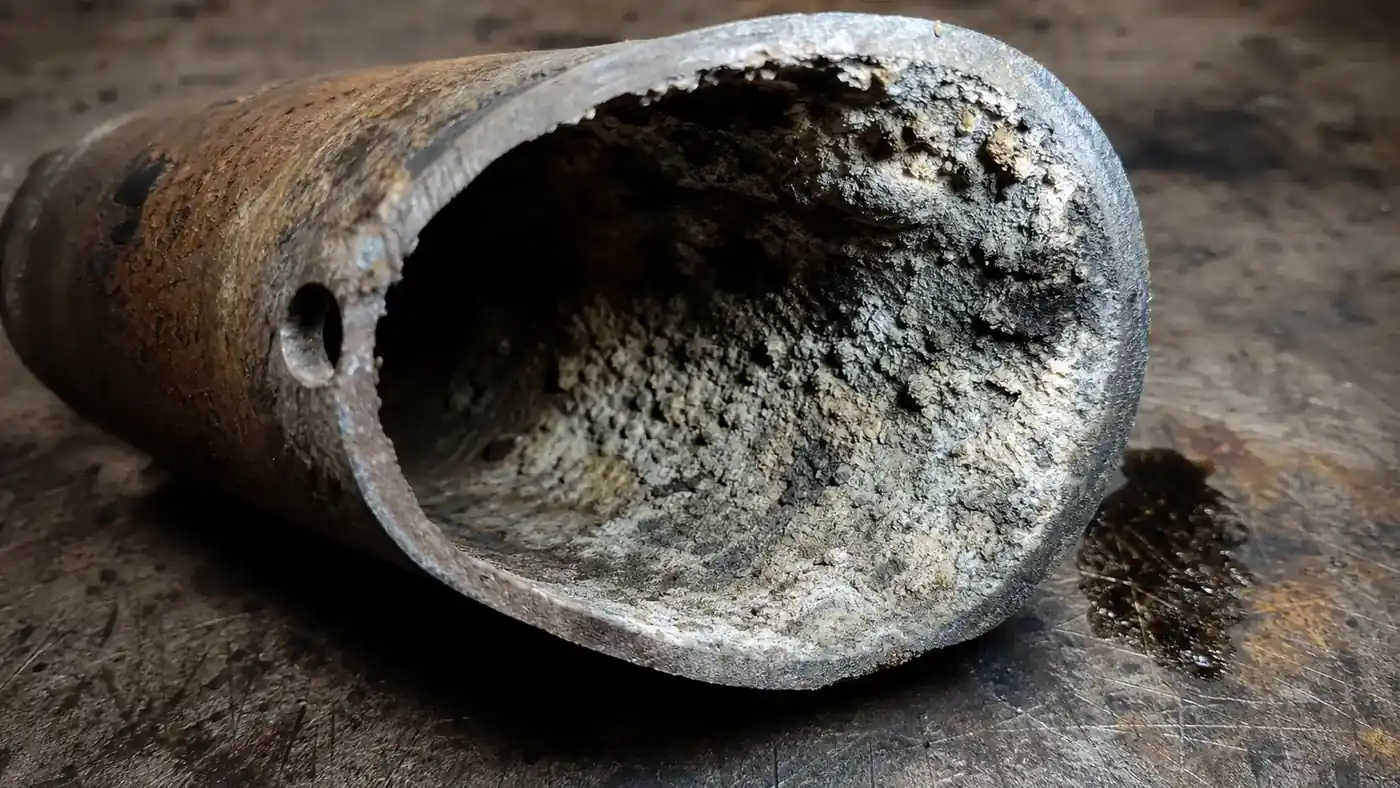
Older Denver housing frequently has cast iron drain lines, and pre-war homes sometimes have galvanised steel branch lines. Both corrode.
Caustic and acidic cleaners accelerate that corrosion. In cast iron the deposits and the pipe wall react differently, and repeated chemical exposure pits the surface. Once the surface is pitted it is rougher, which means it catches more of what passes through it, which means it clogs more readily. So the chemical that cleared this month's clog contributes to next month's.
Galvanised steel is worse, because the zinc coating is what protects it and caustic chemicals strip that coating.
Plastic pipes
The common assumption is that PVC and ABS are immune. They are more resistant, not immune.
The issue in plastic is heat rather than corrosion. Caustic cleaners with aluminium generate genuine heat, and if the product sits against a section of plastic pipe in a fully blocked line, it can soften it. In practice the more frequent failure is at the joints, where solvent cement and rubber seals are less tolerant than the pipe itself, and that shows up as a slow leak rather than a dramatic failure.
Modern PVC will usually survive one application. It is repeated use on a line that keeps blocking that causes problems, and a line that keeps blocking is exactly the situation where people reach for the bottle repeatedly.
The part that matters most
If the line is fully blocked, the drain cleaner does not go anywhere. It pools on top of the blockage and stays there. Everything above happens in one concentrated spot for hours or days, rather than passing through in a few minutes.
That is the scenario in which chemical drain cleaner does real damage, and it is precisely the scenario in which people use the most of it.
Already poured some down there? Tell us when you call so whoever opens the line knows what is sitting in it, on (720) 794-0974.
The safety problem nobody mentions
If the chemical does not clear the clog, the pipe now contains a quantity of caustic liquid.
The next thing that happens is that someone opens that pipe. A trap gets removed, or a cleanout gets opened, and whatever is in there comes out.
This is a genuine hazard for whoever does that work, including you if you decide to have a go with a plunger. Splashing caustic liquid causes chemical burns, and the fumes in an enclosed space under a sink are not pleasant either.
If you have used a chemical drain cleaner and it did not work, tell whoever you call. It is important, it changes how the job is handled, and nobody will think less of you for it. Plenty of people try it first. That is what the product is sold for.
The baking soda and vinegar myth
This one deserves its own section, because it is everywhere.
Baking soda is a base. Vinegar is an acid. Combine them and they neutralise each other, producing carbon dioxide, water and sodium acetate. The fizzing is the carbon dioxide escaping.
That fizzing looks like it is doing something. It is not doing much. The reaction produces a small amount of gas and leaves you with what is essentially salty water, which has no meaningful ability to dissolve a hair and soap plug or a grease deposit.
Where it does have some value: as occasional maintenance on a drain that is still flowing, the volume of water flushed through afterwards, and the mild agitation, can help keep a line from accumulating. As a treatment for an actual blockage, it does very little.
The useful thing here is that it is harmless, which is more than can be said for the alternative.
And the salt thing
You will find advice online to pour salt down the drain every night, sometimes with the claim that it prevents clogs.
Salt is mildly abrasive and it is hygroscopic, so there is a thin rationale. In practice, dry salt tipped into a drain mostly sits in the trap and dissolves. It does not scour a pipe wall, and it will not shift an established grease deposit.
Hot water down a kitchen drain after cooking does considerably more, and costs nothing.
Tried the bottle and it is still blocked? That is the point to stop adding chemicals. Call (720) 794-0974.
What actually works
A plunger. Genuinely effective, and underrated. Get a cup plunger for sinks and a flange plunger for toilets. Block the overflow opening on a sink first, or you are pushing air out of that instead of into the pipe. Most single-fixture clogs come out to a plunger used properly.
A hand auger. Fifteen to twenty-five feet of flexible cable. Reaches past the trap and into the branch line, and physically breaks up or retrieves the blockage rather than trying to dissolve it. Costs about the same as three bottles of drain cleaner and works on things chemicals cannot touch.
Removing the trap. For a bathroom sink, the P-trap under the basin comes off with a bucket underneath and usually hand-tight fittings. A large proportion of bathroom sink clogs are sitting right there.
Hot water and dish soap, for grease. On a kitchen line that is slow rather than blocked, a kettle of hot water with washing-up liquid can shift a soft grease deposit. Not boiling into PVC, and it will not touch an established plug.
Enzyme treatments, for maintenance. Bacterial and enzyme products digest organic material slowly. They will not clear a blockage, and anyone selling them as a fix is overselling. As a monthly maintenance product on a line prone to grease, they are a reasonable thing to use and they do not attack the pipe.
A professional, when it is beyond the above. If more than one fixture is affected, if a hand auger reaches its full length without hitting anything, or if it keeps coming back, the problem is further in than consumer tools reach. That is clogged drain repair.