
What you are actually paying for
A jetter is a different class of machine from a drain cable, and the cost difference reflects that.
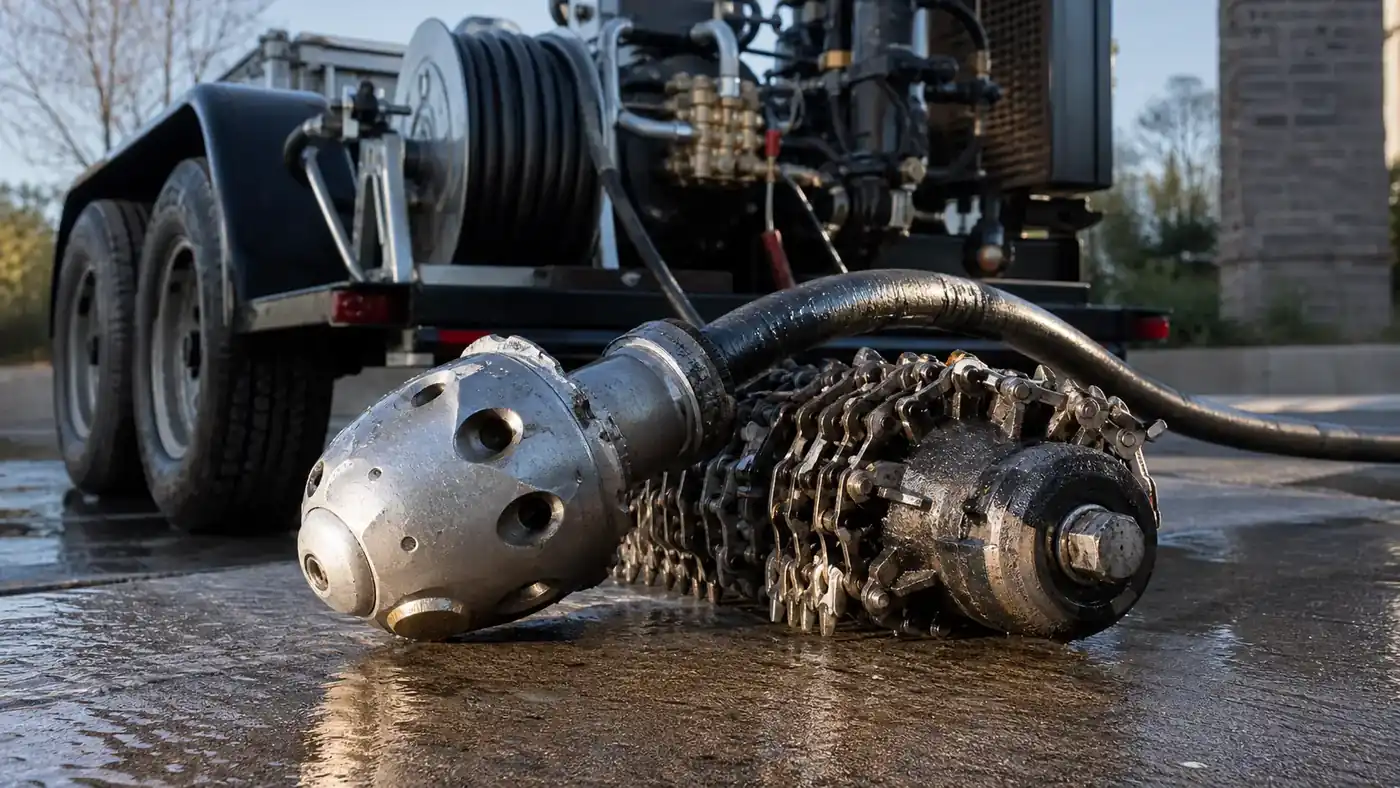
A cable machine is essentially a motor, a drum and a length of steel. A jetter is a high-pressure pump, an engine to drive it, a water supply, hose reels and a set of nozzles. For main sewer line work it is frequently trailer-mounted. It costs considerably more to buy, more to maintain, and it takes longer to set up on site.
It also uses water, sometimes a lot of it, which on a residential job either comes from the property's supply or from a tank on the trailer.
So the price gap between cabling and jetting is not a markup. It is a genuinely different operation.
The seven things that move the price
Fixture line or main sewer line
The largest single factor, as with any drain work. Jetting a kitchen branch line is a smaller machine, less hose and a shorter visit than jetting a 4-inch main sewer line running eighty feet to the street.
How long the line is
Jetting is priced substantially by time, and time tracks length. The nozzle works its way out and cleans on the way back, so a hundred-foot lateral is genuinely more work than a forty-foot one.
Access
The same variable that dominates all drain pricing. If there is an accessible cleanout, the hose goes in and the job proceeds. If there is not, someone has to create access, and in older Denver housing that is common enough to matter. A jetting price quoted over the phone almost always assumes an accessible cleanout.
Whether the line has to be cleared first
This one surprises people. A jetter is very good at cleaning a pipe wall and less good at getting past a solid, packed blockage. If your line is fully blocked, particularly with roots, the usual sequence is to cable it open first and then jet. That is two operations, and it is priced as two operations.
What is in the pipe
Grease comes off relatively readily with the right nozzle. Heavy mineral scale in old cast iron takes longer. Compacted root mass may need a cutting head first. The material determines both the nozzle and the number of passes.
Whether a camera run is included
Some prices include a camera inspection before or after, some do not, and some offer it as an add-on. It changes the number meaningfully, so ask specifically rather than comparing two quotes that are not comparing the same thing. On an older line, a camera before jetting is not an upsell. It is how anyone establishes whether the pipe can take the pressure.
Time of day
After-hours and weekend rates differ by company. Ask before booking.
Been quoted for jetting already? Ask whether the line was camera-assessed first, then call us on (720) 794-0974 for a second opinion.
Jetting against cabling: the real comparison
Here is the calculation that actually matters, and almost nobody presents it.
Cabling a line is cheaper per visit. Jetting is more expensive per visit. If the underlying problem is a coated pipe rather than a discrete blockage, cabling reopens a channel through material that is still there, and the line re-blocks. So the honest comparison is:
Cabling: lower price, more often.
Jetting: higher price, less often.
If your line is cabled twice a year, and jetting would take it to once every two or three years, jetting is usually the cheaper option over any reasonable timeframe even though it costs more today.
If your line blocked once, from a single identifiable cause, and has been fine otherwise, jetting is spending more for an outcome a cable already delivered.
The number that decides it is your actual re-block interval. Not an estimate, not a guess, but how often it has genuinely happened. That is worth working out before you agree to anything.
When jetting is worth paying for
Grease-loaded kitchen and restaurant lines. The clearest case. Grease coats rather than plugs, so cabling is treating the symptom by definition. Commercial kitchens are the strongest example, and there the closed-for-a-day cost usually dwarfs the price difference between methods.
Heavy scale in older cast iron. Denver housing built before about 1950 commonly has cast iron drain lines that have been scaling inward for seventy years or more. A cable passes through the middle of that deposit. Jetting takes it off the wall and restores usable diameter. Provided the iron is sound.
Repeat buildup after cabling. If a cable clears it and it comes back in the same place on a predictable cycle, that pattern is the signal.
After a root cut. Cutting roots restores flow. Jetting afterwards can clean up fine root hair and the surface those roots anchored to, which slows the regrowth.
When jetting is not worth paying for
Being straight about this matters more than the sales opportunity.
A single discrete blockage. An object, one root mass, a solid plug. A cable handles it and jetting delivers the same outcome for more money.
A line whose condition is unknown, on an old house. High-pressure water in a compromised pipe is a real risk. Badly corroded cast iron, deformed Orangeburg, clay with separated joints. Nobody can rule those out from a phone call, and the appropriate step is a camera, not a jetter.
A line with a structural problem. If a section has collapsed or a belly is holding water, cleaning does not address the cause. Jetting a pipe with a belly in it will produce a clean pipe that still holds water and still blocks.
A newer PVC line with one blockage. Modern plastic is smooth and does not scale. If a twenty-year-old PVC line blocks once, something went into it. Clear it and move on.
Describe the pattern, including which line, how often it blocks and what has been tried, and we will tell you whether jetting is even the right conversation. Call (720) 794-0974.
What to ask before you agree to jetting
Five questions. Any competent company will answer all of them without hesitating.
- What are you basing this on? Has anyone looked at the line, or is jetting being recommended because it is the higher-priced option?
- Does the price assume an accessible cleanout? If it does and you do not have one, the number will change.
- Does it include clearing the line first if it is fully blocked? Or is that separate?
- Is a camera inspection included? Before, after, both, or not at all.
- What do you expect this to buy me in time? Not a guarantee, which nobody can honestly give, but a realistic expectation based on what is in the pipe.
If the answer to the first question is vague, that is the one to press on.
More on the method itself: hydro jetting in Denver. For pricing across every drain service, see what drain cleaning costs in Denver.